
Survival in the Gig Economy
Freedom from the nine-to-five or another form of exploitation? The gig economy is both!
Book gives you the truth about about what to expect and helps you make a plan when nothing is predictable.
Freedom from the nine-to-five or another form of exploitation? The gig economy is both!
Book gives you the truth about about what to expect and helps you make a plan when nothing is predictable.

Many of us remember the case of New York Times v Sullivan, 376 U.S. 254 (1964) from law school because it appeared in both our torts class (libel and defamation) and our Constitutional law class (First Amendment and freedom of speech). As most of us know, “freedom of speech” is not absolute, although it is entitled to the highest level of scrutiny (i.e., strict scrutiny). That is, the government may restrict speech, so long as there is a “compelling government interest” and the restriction is “narrowly tailored” to effectuate that interest with minimal infringement on speech. The law of libel evolved out of this, allowing lawsuits against publication of stories that were (1) false, and (2) damaged the plaintiff’s reputation. In most cases, the plaintiff (the person suing) has the burden of proving that the statement was false. The plaintiff also has the burden of proving damages (to reputation, lost business, etc.). However, many states also allow statutorily defined “libel per se,” which is automatically presumed sufficiently harmful that the Plaintiff need not prove actual damages.
So, what was NY Times v Sullivan about? At the height of the civil rights era, the New York Times published an advertisement disparaging the actions of the Montgomery Alabama Police. L.B. Sullivan, a Montgomery City Commissioner, sued the Times for libel, and an Alabama jury awarded Sullivan $500,000 (equivalent to just over $5.1 million today). The purpose of the ad was to solicit donations to help in the legal defense of Martin Luther King. The ad contained a few minor inaccuracies, but it never specifically mentioned Sullivan by name. The trial judge had instructed the jury that the statements in the ad were libelous per se, which meant that malice was presumed, and the Plaintiff (Sullivan) did not have to prove actual damages. Obviously, the Defendants appealed, and the case ended up at the U.S. Supreme Court.
As framed by Justice Brennan (author of the main opinion), the legal question presented was the “extent to which the constitutional protections for speech and press limit a State’s power to award damages in a libel action brought by a public official against critics of his official conduct.” The duty of a free press is to hold elected officials accountable. That is, our elected officials should be—and should expect to be—subject to the strictest of scrutiny. At the same time, the media should not be given free license to destroy someone’s career with a lie.
The media is often under a deadline pressure and may not have sufficient time to check every fact and vet every source. Moreover, the timeliness of publication may also be salient to the public interest (i.e., a decision or vote is imminent and the public needs to know in sufficient time to act). In concluding that “libel can claim no talismanic immunity from constitutional limitations. It must be measured by standards that satisfy the First Amendment,” the Court announces a new doctrine that requires a government official who sues a media outlet for libel to prove “actual malice.” Actual malice does not necessarily mean personal animosity toward the official but is legally defined as “knowledge of [the statement’s] falsity or with reckless disregard of whether it was true or false.” Thus, so long as a media publisher conducts a reasonable inquiry, fact checking, etc., a Plaintiff who is considered a “public figure” (more legal definitions) cannot prevail in a libel suit.
Justice Brennan eloquently cites a litany of historical First Amendment jurisprudence:
“Those who won our independence believed . . . that public discussion is a political duty, and that this should be a fundamental principle of the American government. They recognized the risks to which all human institutions are subject. But they knew that order cannot be secured merely through fear of punishment for its infraction; that it is hazardous to discourage thought, hope and imagination; that fear breeds repression; that repression breeds hate; that hate menaces stable government; that the path of safety lies in the opportunity to discuss freely supposed grievances and proposed remedies, and that the fitting remedy for evil counsels is good ones. Believing in the power of reason as applied through public discussion, they eschewed silence coerced by law — the argument of force in its worst form.”
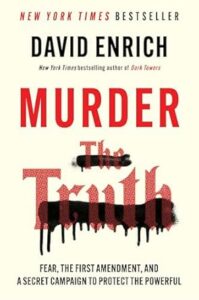
I have provided this background so that those who have not been to law school will understand the argument in Murder the Truth. For half a century, the “actual malice” standard was deemed to be the correct balance between the protection of reputation and the public’s right to know: It allowed the media to publish negative stories about the wealthy, famous, powerful and privileged without fear of costly lawsuits due to innocent mistakes, or even carelessness that did not rise to legally defined “actual malice.”
However, the powerful and the privileged do not like negative attention in the press. David Enrich is an investigative journalist for The New York Times who covers business, legal and financial stories. Enrich delves deep into what he alleges is an “under-the-radar legal movement that is weaponizing the obscure field of libel law.” This movement is being powered by a “clique of high-powered lawyers…motivated by a mixture of profits and politics,” whose ultimate objective is the overturning of New York Times v. Sullivan and the actual malice standard.
Enrich sets the stage for the New York Times v. Sullivan case, exposing Sullivan as an “unapologetic bigot.” We next hear about the contentious confirmation hearings of Supreme Court Justice Clarence Thomas in 1991, and the “burning anger” he had developed toward the media. In 2019, a celebrity defamation case came before the Supreme Court: Kathrine Mae McKee v William Cosby.
The former actress (and now casting director) Kathy McKee had previously alleged that Bill Cosby had raped her some 40 years prior. However, McKee was not suing Cosby for sexual assault, but rather because Cosby’s attorney had leaked a letter to the press disparaging McKee’s truthfulness and honesty. [Personal comment: This is why so many rape victims do not come forward or press charges because they are usually “raped again” in the media]. The lower courts found that McKee had not met the burden of proving actual malice and the Supreme Court denied review (declined to hear the case). Justice Thomas, perhaps being triggered by another white woman accusing a Black man of sexual misconduct, agreed to the dismissal, but filed a concurring opinion questioning the applicability of Sullivan, arguing that there was no historical or constitutional basis for the decision in that case.
All of us today are more than familiar with Donald Trump’s accusation of “fake news” and calling the media “the enemy of the people.” But there is more mischief afoot than a couple of rich and famous disgruntled narcissists who don’t like how they are portrayed in the media (however truthful it may be). While NY Times v. Sullivan has not been overruled, the flurry of lawfare and threatened litigation has created a chilling effect on publication decisions. This trend has “exacerbated a crisis in which thousands of newspapers have vanished, and tens of millions of Americans now lack reliable sources for local news—a trend that has contributed to the spread of disinformation, the polarization of politics, and a new era of impunity for elected officials and big companies.”
The decline in local news can be attributed to more than aggressive libel suits (or threats) from the wealthy and powerful. Seventy million Americans now live in what researchers term “news deserts….When no one is monitoring city council or school board meetings, studies have found that civic engagement withers, politics polarize, and taxes go up.” A robust media not only helps to keep our elected officials accountable, it is fundamental to the health of our civic life.
Enrich tells the tale of The Gazette, founded in 1872 under the original name of Out West, The Gazette grew to become Colorado’s second largest newspaper. It seemed to be defying the negative trends that affected most other local papers, earning a couple of Pulitzer Prizes along the way. However, in 2012, The Gazette was purchased by billionaire Phil Anschutz, “part of a broader pattern of local and regional newspapers being gobbled up by wealthy individuals and conglomerates.” Journalists at The Gazette had initially celebrated the deal, since they presumed that a deep-pocketed benefactor would allow the paper to continue its investment in investigative journalism. But the old-time journalists soon noticed that Anschutz’s hand-picked editors were “watering down” stories that were critical of the new owner’s business interests.
Enrich here tells the story of a young journalist named Swanson who was sent to investigate Gold Hills Mesa, a Colorado Springs development. A mining operation had previously maintained a facility that processed 1,500 tons of ore per day using arsenic and other dangerous chemicals. The leftovers of this process—which contained toxic dregs known as mine tailings—were dumped into a basin that became Gold Hill. A couple of Gold Hill Mesa homeowners met with Swanson, who described soaked carpeting in the basement, a cement floor warped and cracked, and fractured foundations. When the homeowners complained to officials, they were subjected to a campaign of harassment from other homeowners in the development. They spent $500,000 in legal expenses, finally getting Gold Hill Mesa to buy back their home (at a price well below what they had paid for it).
The homeowners shared the research they had collected during litigation with Swanson. Swanson also did his own research, mainly focusing on public records and first-hand statements from homeowners. He also discussed his findings with Gold Hill Mesa officials, inviting their comments and genuinely attempting to present both sides. But Gold Hills Mesa was already at work attempting to derail the story. Two days after The Gazette published Swanson’s story, the paper received a cease-and-desist letter from an attorney, accusing Swanson of an “irresponsible and libelous article” containing false and defamatory statements.
To its credit, Swanson’s editor and The Gazette did not back down. Swanson’s article was backed up with voluminous public records, including warnings from the Colorado Geological Survey and senior geologists. But the legal threats kept coming, and Swanson noticed a “change in the newspaper’s attitude toward his reporting.” The homeowners who had initially met with Swanson were also subject to threats of being sued for defamation. Swanson left The Gazette after being offered a job at The Denver Post.
According to Enrich, “the revolution started” when tech billionaire Peter Theil set his sites on destroying Gawker, an online-only platform that focused on celebrities and the media. Silicon Valley tech billionaires had become accustomed to being lionized in the media, but Gawker’s brand was confrontational and skeptical, and it started challenging Silicon Valley’s inflated image of itself as well as traditional media’s fawning and toothless coverage of it. Theil believed that Gawker’s stories were causing investors to pull money out of Theil’s hedge funds.
Enrich traces the connections leading to the recruitment of a then-relatively unknown Hollywood attorney named David Harder. Enrich then traces the strategy to bring down Gawker to the Hulk Hogan sex tape story and the decision for Harder to sue Gawker for invasion of privacy and demand for $100 million. “Gawker wasn’t the type to back down. Not realizing that Hogan was endowed with essentially infinite resources, the site’s lawyers set out to chisel him down with endless motions and appeals.” (This is a fairly typical corporate strategy when it is sued by resource-constrained former employees and customers).
Enrich follows the trial, where jurors seemed to sympathize with Hogan, viewing Gawker’s founders as being “all about the almighty dollar” and showing no remorse for being so willing to publish the tawdry tape. It took the jury less than six hours to award Hogan $115 million in compensatory damages, then tacking on another $25 million three days later in punitive damages. At that time, Gawker’s entire company was valued at $85 million. Not only had the previously unknown Harder made a name for himself (one journalist called him “perhaps the greatest threat in the United States to journalists, the First Amendment, and the very notion of a free press”), the word was out that there could be big fat paydays in defamation suits against media companies.
We next meet a couple of high-powered attorneys who made names for themselves (as well as a fortune) by suing (or threatening suits against) media organizations on behalf of wealthy or famous persons. Libby Locke and Tom Clare met while both were employed at Kirkland & Ellis, one of the big multinational law firms that generally represents the corporatocracy. Enrich tells how Clare took Locke under his wing, and the two eventually married and left Kirkland to start their own law firm, specializing in defamation cases against media companies. Clare and Locke had found a lucrative niche, generally charging upwards of $1,200 per hour on top of tens of thousands of dollars in fixed fees. The cost to have Clare Locke merely threaten to sue could cost around $100,000.
Like many right-wing attorneys, both Clare and Locke are members of the Federalist society, which also has a stranglehold on Supreme Court nominations and jurisprudence. Locke had made a name for herself in conservative circles, appearing as a featured speaker at Federalist Society conventions. Locke also appeared as a guest on Fox News, complaining to Tucker Carlson how hard it was to win defamation suits and often echoing Trumpian excoriation of the media.
While the purpose of the First Amendment is to prevent government from suppressing speech that offends officials, there is nothing to prevent wealthy private persons or corporations from using money to suppress speech by threatening costly lawsuits. Wealthy and privileged people are more than happy to use the media to promote themselves or push stories that help them add to their fortunes. They are also quick to frame themselves as media victims if a story about them or their activity is negative.
One of the first cases where we see government officials rather than celebrities suing for defamation is Tah v Global Witness. Two former Liberian officials sued Global Witness, an international human rights organization, alleging that Global Witness had published a report (titled Catch Me If You Can) that falsely implied the officials had taken bribes in connection with an Exxon oil license. Although both the trial and appeal court dismissed the case on the basis that the plaintiffs had failed to prove actual malice, one judge dissented.
Larry Silberman (now deceased) is another Federalist lawyer and friend of Clarence Thomas who had built a career helping wealthy and powerful clients evade accountability—the Reagan administration in the Iran-Contra scandal and Bill Clinton with the Monica Lewinsky scandal. Silberman’s dissent cited the Thomas dissent in McKee, calling NY Times v. Sullivan “a policy-driven decision masquerading as constitutional law” and “unjustified legal rules that serve only to enhance the press’ power.” Silberman conceded that the court’s objective was justified during the civil rights era, but it had given the media too much power, “allowing [the media] to cast false aspersion on public figures with near impunity.” Although the U.S. Supreme Court declined to hear the case, Silberman’s opinion carries “immense weight with his legions of admirers.”
Enrich traces the anti-Sullivan sentiment to another international case, Shkëlzen Berisha v. Guy Lawson, et al. The son of Albania’s former prime minister sued the journalist whose book became the basis for the movie War Dogs. Enrich again follows the twists and turns of the case, which is also eventually dismissed. But this time, Justice Gorsuch joins Justice Thomas in the dissent. Gorsuch “was grumbling about a lack of media fact-checking and how Sullivan had made it harder for defamation victims to prevail in court,” citing a false statistic that defamation plaintiffs won in only one-out-of-ten cases.
Enrich points out that defamation plaintiffs had actually won damages. Between 2010 and 2017, juries awarded damages to defamation plaintiffs in 21 cases. Although jury-awarded damages were affirmed on appeal in only two of the cases, four of the cases were never appealed at all (jury award stands), 8 of the cases settled prior to appeal (reduced damages were likely the result), and in four cases the damages were modified but not reversed. One lawyer at Media Law Research Center wrote a letter to Gorsuch, pointing out inaccuracies cited in his dissent, and a few weeks later the Supreme Court retroactively altered the Gorsuch dissent. “Despite the quiet correction, the false one-in-ten figure would become a talking point for lawyers and others seeking to overturn Sullivan.”
Even before he became Governor of Florida, Ron Desantis had “positioned himself as an anti-elitist culture warrior” doing battle against the media and “woke culture.” Desantis would “be the second presidential candidate, after Trump in 2016, to try to transform the seemingly arcane field of libel law into a political weapon.” Libby Locke became his friend and advisor, sometimes providing services pro bono. With Locke’s assistance, Desantis attempted to push through legislation that would make it easier for plaintiffs to win against “these massive media conglomerates.” Ironically, Desantis’ proposed legislation was opposed by right-wing broadcasters, who “warned that the bill would be the death of conservative talk radio throughout the State of Florida.”
The next attorney we meet is Matthew Fernholz. After graduation from Milwaukee’s Marquette University School of Law, Fernholz became a rising conservative star when then-Governor Scott Walker appointed him to a government commission and two years later the conservative Wisconsin Supreme Court appointed him to another. “Fernholz’s big splash came in 2020, when he represented a businessman who sued to overturn the statewide mask mandate imposed by Wisconsin’s Democratic governor.” A case which Fernholz won when the Wisconsin Supreme Court ruled in his favor in 2021.
In law school, Fernholz had been captivated by the Thomas dissent in McKee and the Silberman dissent in Global Witness. The businessman who sued about the mask issue then hired Fernholz to challenge Wisconsin’s use of drop boxes. Fernholz’s first libel case came when a conservative news organization sued the liberal owner of a local brewery who had accused the publication of being a “crook.” Fernholz won a $750,000 judgment against the brewer, the largest defamation award ever in Wisconsin history. So, now we are seeing a twisted reversal where a media outlet sues a business owner rather than the more typical case of the opposite.
In the next scenario, we return to a local business owner suing the local media: A man named Corey Tomczyk, who owned a company called IROW. Tomczyk attended a local board of supervisors meeting when a teenager who appeared to be transgender stood to speak. Someone in the audience said, “There’s fag number one.” A reporter for a small local publication overheard the remark. A few members in the audience identified Tomczyk as the person who said it. The local publication (Pilot) published the story, identifying Tomczyk as the source of the slur without ever contacting Tomczyk to get his version of events. When Tomczyk saw the story, he was “incensed.” Someone connected him with Fernholz.
We see behind the scenes on both sides. The reporter was experiencing health problems—both her own and with family. Thousands of pages of internal emails and sworn affidavits were exchanged during discovery. The conservative judge who heard the case dismissed it, finding that Tomczyk was a “public figure” as a participant in the issue that was before the board of supervisors, and that the Pilot had taken sufficient steps to confirm that Tomczyk was the one who spoke the slur (which Tomczyk denied throughout the litigation). Even assuming that the Pilot could have done more to investigate, Tomczyk presented no evidence that “the defendants had serious doubts about the truth of the publication.”
Enrich briefly discusses the potential defense of anti-SLAPP legislation. A SLAPP lawsuit, aka Strategic Lawsuit Against Public Participation, is a lawsuit that is filed specifically to silence someone who is speaking out against the wealthy, privileged and powerful. Typically, SLAPP Plaintiffs don’t necessarily expect to win the lawsuit, but hope that the threat of litigation will cause unfavorable stories to be withdrawn or not even published in the first place. What anti-SLAPP legislation does is allows defamation defendants to ask courts to have cases dismissed early in the litigation (thus saving potentially huge legal expenses), provided they are able to prove certain elements. Anti-SLAPP statutes are in essence specialized 12.B.6-style Motions to Dismiss for defamation and libel cases.
Depending on the source, some 35 or 38 states have some form of anti-SLAPP statute. There is a lot of variation in how state anti-SLAPP statues actually operate, and no surprise that these statutes are often challenged on constitutional grounds. I was fortunate to witness the first anti-SLAPP legislation introduced in Texas during the 2011 session. The Texas statute survived challenges, with amendments going into effect in September 2019 that actually beefed up a defendant’s rights to free speech, association and petition. Here in MN, an anti-SLAPP statute that passed in 1994 was found unconstitutional in 2016. Governor Walz signed the Uniform Public Expression Protection Act on May 24, 2024, so we will see. The Reporters Committee for Freedom of the Press gives a good state-by-state analysis of anti-SLAPP legislation currently in effect.
Enrich walks us through a few more cases where Sullivan is challenged and survives before he gets to the story of “the Case of the Century.” About three weeks after the 2020 election, Tom Clare received a phone call from Dominion Voting Systems. In an ironic twist of loyalties, Clare Locke was “about to play a key role in holding one of the country’s most power media outlets to account.” We get a fascinating inside account of the litigation behind the ultimate $787.5 million verdict against Fox News.
Tom Clare and Megan Meier were assigned to depose Tucker Carlson. “Over and over, Carlson was asked about his views about the 2020 election, his misogynistic language toward women, even where he was domiciled. The TV host suspected he was being accused of tax evasion. He repeatedly had to stop himself from responding to Clare’s questions with a simple ‘fuck you.’”
The Dominion litigation was not just a huge win for Clare Locke in its own right, it led to more potential defamation paydays filling the pipeline: Newsmax, One America News, My Pillow, Sidney Powell, and Rudy Giuliani. As I write this, apparently News Max just settled with Dominion (all while professing its journalist integrity) for $67 million. The multiple Dominion paydays refute the complaints that Sullivan is too restrictive. Yes, folks, when the lies are obvious and an unscrupulous media empire continues to push them, defamation plaintiffs can win—and win big.
Yet, Enrich concludes that Sullivan is not safe. “Indeed, the fates of the current crop of lawsuits designed to kneecap the Sullivan precedent—such as Sarah Palin’s action against the Times or Alan Dershowitz’s against CNN—might not be known for years. Perhaps they will fail. Maybe they will only partially succeed…it is not hard to envision the Supreme Court substantially narrowing the scope of who classifies as a public figure or even ruling that the actual malice standard should only apply to government officials.”
“The consequences of such a shift—much less an outright reversal of Sullivan—are likely to be stark: a damper on investigative journalism, especially into companies, universities, religious institutions, and their leaders. Greater legal risks and higher insurance costs—and therefore lower odds of survival—for community newspapers and upstart media outlets. New dangers for anyone who speaks up about wrongdoing by authority figures or big business.”
Enrich also puts the risks into the unique context of our time: A President who lies about election results, calls journalists “the enemy of the people” and jokes about them getting shot, in addition to suing outlets like CBS for billions of dollars. In addition to the President, we have one Supreme Court justice who has failed to disclose gifts from billionaire “friends” with business before the Court and another Justice who flew a flag associated with January 6th outside his home while ruling on criminal cases involving the attempted insurrection. “Both scandals came to light because of investigative journalism…” We cannot allow the wealthy, powerful and privileged be the ultimate gatekeepers of the truth.