
Survival in the Gig Economy
Freedom from the nine-to-five or another form of exploitation? The gig economy is both!
Book gives you the truth about about what to expect and helps you make a plan when nothing is predictable.
Freedom from the nine-to-five or another form of exploitation? The gig economy is both!
Book gives you the truth about about what to expect and helps you make a plan when nothing is predictable.

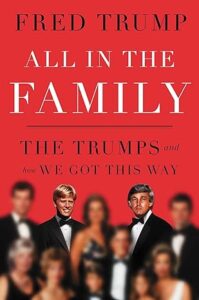
Fred Trump (herein also referred to as Fred III) is the nephew of Donald Trump and the brother of Mary Trump, who has also written a few books about her (in)famous family (Too Much and Never Enough in 2020 and Who Could Ever Love You in 2024). Fred’s account corroborates a lot of what we already know from his sister, Mary, although it is from his own perspective.
There is nothing really new or surprising as far as historical facts. What we do see is that Fred III, like his sister Mary and his father Fred Jr—notwithstanding his struggle with alcoholism—all seem to be basically decent human beings. Which tells us that good people can come out of dysfunctional (and even corrupt) families and backgrounds.
Fred’s account makes his family practically seem human. Fred himself struggles with trying to maintain harmony in the family just for the sake of being family.
We learn more about Fred’s unique struggles when he lost his father to alcoholism and the ongoing challenges with his disabled son William. It was the cost of William’s medical care that seemed to drive the motivation behind Fred’s suing his uncle Donald, rather than personal animosity.
One cannot really describe the Trump family as “close,” but the patriarch (Fred Trump Sr, Donald’s father and Fred’s grandfather) kept everyone tethered to “The House” he built in Jamaica Estates Queens. Fred reports that, “Half of my childhood, it seemed, unfolded at my grandparent’s house.” Every holiday and many Sunday dinners, Fred Sr. would hold court, telling everyone what was happening in the business, in politics, at city hall or who said what to whom, while everyone just nodded along. After dinner, Fred Sr. would retreat to the “library,” which ironically contained no books of any kind.
The Trump children (Donald’s generation, which also included his older sister MaryAnne, Fred III’s father Fred Jr, his sister Elizabeth and his younger brother Robert) continued to gather in the home of patriarch Fred Sr., even after they went away to college and started families of their own. Fred attributes this to his grandfather’s “domineering personality” as well as how successful the family business (that Fred built, not Donald) was and “how many family members found places for themselves there.”
Fred’s family was always a sort of “black sheep” with the Trump family. As the oldest son, Fred’s father (Fred Jr.) was destined to take over the family business. Fred Jr. was always popular in school. He was not the brilliant scholar like his older sister MaryAnne but also not the troublemaker like his younger brother Donald. Fred details the story of how his parents met and married, along with how his mother was treated with indifference and condescension at Trump family gatherings. Yet, they would always go to visit Grandpa Fred and not Linda’s family in Florida.
Fred Jr.s dream was to be a pilot. He had learned to fly on his own, and Fred III has fond memories of both flying and fishing excursions with his father. In December 1963, Fred Jr. shocked the entire family when he announced he had been accepted into the TWA pilot training program and was leaving the family business. Although Fred Jr. was already drinking “pretty hard,” he completed the training and six months later was flying passengers from Boston to Los Angeles, one of TWA’s more prestigious routes. Then one day, Donald and Robert arrived, apparently on orders from Fred Sr. to bring Jr. back to Queens and the family business. Before Fred Jr. could become a full-fledged pilot, TWA let him go, and by Christmas 1964 he was back in New York. Fred III cannot say if this was due to alcohol, family pressure, or both.
Fred III was aware of Fred Jr.’s drinking even from an early age. Fred III suggests his father’s alcoholism was driven by conflicts with Fred Sr. over running the business. Young Fred would often overhear his parents arguing, and then one night Lisa rounded up the kids (Fred and his sister Mary) and left the home. Although his parents separated and ultimately divorced, Fred III continued to maintain a relationship with his father, visiting him at his frequently changing apartment addresses. While Linda (Fred III’s mother) could not live with Fred and his drinking, she also still cared about him on some level. In spite of being the “black sheep” of the Trump family, Fred Jr. was never expressly excommunicated or banished from it either.
Fred III was seven years old when his parents separated and then divorced. Fred reports that this experience (suffering through the divorce of his own parents) primed him to sympathies with his cousins Donald Jr., Ivanka and Eric, during the “scandalous media coverage of Donald’s very public affair with Marla Maples” and divorce from Ivana.
We get a few brief glimpses of his Uncle Donald’s competitiveness and cruelty. Fred was always closest to his Uncle Robert, Donald’s youngest brother. They would often toss baseballs in Fred Sr.’s yard. One day, out of the blue, Donald ordered his nephew Fred to hit his brother Rob. Not explaining what exactly prompted him to do so, Fred says he punched Rob in the arm. Rob was sufficiently surprised that he slapped Fred back in the face. All the while Donald was laughing so hard he had to catch his breath.
Fred describes another time when Donald and Fred’s cousin David were playing catch in the yard. Donald started throwing the ball harder and harder, “until he was firing rockets at his nephew.” Donald was laughing and thoroughly enjoying the sight of David’s distress. The last fastball hit David in the head and knocked him to the ground. “With Donald, almost everything had to be a competition….a win was a win was a win, whether or not the other person even knew the game was on.”
Fred III tells one story (which he must have overheard from his father) when Donald was being “particularly obnoxious,” so Fred Jr. got back at him. Donald always hated snakes, so Fred Jr. rounded up a harmless garter snake from their Jamaica Estates neighborhood and dropped in into his little brother’s unmade bed while Donald was taking a bath. This time it was Donald’s turn to scream and Fred’s turn to laugh.
Donald registered for the draft in 1964, as the law required, and then got a student deferment. He spent two years at Fordham, then transferred to Penn. When Donald graduated in 1968, his draft status was now 1-A, “putting him at the front of the line for compulsory service in Vietnam.” Fred Sr., using the same tenacity and network of connections that had built his business and gotten Donald admitted to Penn, sent Donald to a podiatrist who rented space in a Fred Trump building and apparently owed Fred Sr. a favor. The doctor (who is named in the book) wrote the famous “bone spurs” letter, although no one in the family was aware that Donald—who had been captain on the NY Military Academy baseball team—had ever had any problem with his feet. Donald’s Selective Service classification was changed from 1-A to 1-Y (which meant that he would only have to serve in case of a dire emergency, like the US being invaded).
When President Nixon took office, he faced increasing public complaints that the draft system favored the wealthy, well-connected and educated. By late 1969, men were selected for service through a draft lottery. Some 850,000 men born between 1944 and 1950 had slips of paper with their birthdays sealed in small capsules and then dumped into a giant glass jar. A capsule would be randomly picked out, and that person’s birthday (and everyone else with that birthday) would have the lowest lottery number. Names would continue to be picked until all possible 365 birthdays were assigned a number.
Fred tells the story of the Trump family, gathered in the Trump library, watching anxiously as names and birthdays were pulled. The first date was September 14th (a collective “whew”). Trump’s younger brother Robert’s birthday (August 26) came up at 245. Donald’s birthday—June 14—wasn’t chosen until number 356—less than 10 numbers from the very last. No one can say that the Trump family is not lucky.
Fred III attended college at Rollins in Winter Park, Florida—which he had deliberately chosen because it was closer to his mother’s family. On September 27, 1981, his mother’s cousins from Orlando called very early in the morning and told him they were coming by to take him to an art exhibit. Feeling that this was strange, Fred nonetheless agreed to go. When his cousins arrived, they told Fred that his father had passed away the night before. Fred Jr. was only 42 years old. The official cause of death was a heart attack due to alcoholism.
Donald and Robert asked Fred to “say a few words” at his father’s funeral. No one else wanted to say a word. So Fred had to work through his own grief and deliver a eulogy for his father. He focused his message on his grandmother (who he had always been close to) and his sister Mary: “I know you and Dad had your differences, and you may not have been so close at the end. But Mary, Dad really loved you. He loved you so much.”
We learn that Fred and Lisa were married by a Presbyterian minister and a Rabbi in an old Quaker meetinghouse that had now become an interfaith house of worship. Donald and his then-wife Ivana showed up for a quick photo and then had to leave to get back to Atlantic City. We follow Fred and Lisa through the birth of their first daughter Andrea on December 20, 1993 (the same day Trump married his second wife). Twenty-three months later, Fred and Lisa welcomed a new son, Christopher.
Fred states it was “no accident that I ended up in commercial real estate…having grown up around the business.” But one lesson Fred learned from his father was “Don’t work for your family.” Fred has gone on to build his own successful career, even if it is nothing like the Trump empire. He describes how he nonetheless could not escape from his grandfather’s reputation in the business—not to mention his uncle’s growing notoriety—which could sometimes seem like a double-edged sword.
When patriarch Fred Sr. died in 1999, MaryAnne asked Fred to again deliver the eulogy. Fred obliged, and when he got home he went to bed, only to be awakened when Lisa’s water broke around 1 am. Fred’s third child, William was born at 6:25 am. At first William seemed to be a normal healthy baby. Then he couldn’t stop crying. Then he turned blue. The next thing was William being rushed into the Neonatal Intensive Care Unit where he stayed for three more weeks. This is followed by years of multiple, intense and expensive medical procedures and care, and the medical professionals could not pinpoint exactly what was wrong with William. This part of Fred’s story is the most heart-wrenching, and it will likely strike a chord with any parent who has a special needs child.
One day in early 2000, Fred and Mary receive a call from one of the Trump family attorneys telling them that Grandpa Fred’s “wishes had changed.” In Fred’s original will, the one-fifth portion of his estate that would be distributed to each of his five children would devolve to be split between Fred and Mary. Before making a decision about what to do, Fred and Lisa took William (now out of the hospital) to meet his great-grandmother (the Trump matriarch who Fred refers to as “Gam”). Gam immediately bonded with William, even asking questions about his medical issues. “What a precious little boy he is. Don’t worry dear. As long as he lives, he will never want for anything.”
Donald was serving as the executor of his father’s estate, but the Trumps sent Robert—who often was sent to do the family’s dirty work—to get signatures from Fred and Mary. They both refused to sign. On March 23, 2000, Fred and his sister Mary hired a team of lawyers to file objections to the probate of the patriarch Fred Trump’s estate. While this decision was mostly based on moral grounds (Mary said, “They’re stealing from us”), for Fred it was also about ensuring the means to take care of William.
Donald and his siblings hired Louis Laurino. Laurino had been appointed as a judge to the Queens County probate court in 1971 by Governor Nelson Rockefeller. Laurino had both experience and influence, as well as a history of unethical conduct. Laurino was censured by the State Commission on Judicial Conduct for conflicts of interest, and he resigned as a judge in 1991. Laurino told Fred that they were cutting off medical insurance—the insurance that Fred Sr. had established to cover all of his family and was now paying for William’s care. “Of all the cruel, low-down, vicious, heartless things my own relatives could do to me, my wife, and my children, this was worse than anything else I could possibly imagine.”
Fred describes the legal process as well as things that were revealed during discovery. No surprises here, the Trump’s hit hard and dirty. When the time came before the Judge, Fred reports that the Judge seemed to want everyone to “go off somewhere and settle the damn thing.” Fred describes the last phone call he had with “Gam,” who had either declined mentally or been influenced by Fred’s siblings: “I hope you die penniless just like your father did.”
During discovery, Fred found out that Donald, who for all the hype about his success, was getting “squeezed by the banks” in 1984. His entire gambling empire was in “severe financial distress.” By 1990, Donald’s company owed $4 billion to 72 different financial institutions, all while Donald was bragging that Ivana was demanding “a billion dollars” in their divorce settlement. In December 1990, Donald sent two of his father’s most trusted financial advisors to get Fred Sr. to “sign documents.” At that time, Fred Sr. was 85 years old and not yet showing signs of dementia. Fred refused to sign. Donald had got his sister MaryAnne (a respected attorney) involved as well, and explained to Fred Sr. that he needed to make changes to protect Donald’s share from creditors. At that time, Maryann also advised her father not to sign.
When this first attempt to get Fred Sr. to change the language in his will failed, Donald kept persisting, getting his siblings to share in Executor duties. One small change, “to my children who survive me” made the difference between Fred III and his sister Mary splitting one fifth of Fred Sr.’s substantial estate or only receiving $200,000 (which is a lot of money for most of us) along with the other Trump grandchildren (who would still inherit the rest from their own parents). Fred III admits that Fred Sr.’s “disappointment with my father,” as well as his choice of wife—made Fred Sr. “susceptible to Donald’s pressure.” On September 18, 1991, Fred Sr. signed the new draft of the will that Donald was urging. No one ever said anything to Fred III and Mary.
Both Mary and Fred were racking up huge legal bills—on top of William’s gigantic medical bills. As shifting settlement numbers were offered, Fred wanted to settle and Mary wanted to hold out. They finally agreed to a deal on April 10, 2001. “Mary came to believe that our lawyers weren’t really fighting for us, they were conflicted or corrupted…I think this is what happens in a hard-fought negotiation. Neither side gets what they want, especially when one of the plaintiffs doesn’t want to spend his whole life at war. I take the rap for that.”
In the last third of the book, Fred describes the process of reconciling with his Aunts and Uncles after the lawsuit was settled and animosities had an opportunity to cool down. Fred writes, “I still felt like my sister and I, and the people who depended on us, were the ones who had gotten screwed. But you can’t live in that anger forever.”
After the death of patriarch Fred Sr., the family orbit had now shifted to revolve around Donald. Donald’s sisters MaryAnne and Elizabeth both had purchased homes within walking distance of one of Donald’s clubs. MaryAnne, who was the “brain” of the family, was hired by the U.S. Attorneys office in 1974 (when fewer women even went to law school), where she rose to head the US Attorney Appeals office in New Jersey. She was appointed as a federal district judge by Ronald Reagan, and then to the Third Circuit Court of Appeals in New York by Bill Clinton (showing that she had bipartisan appeal). MaryAnne apparently earned her career on her own merit, without assistance from Fred Sr.’s family connections. One of MaryAnne’s clerks at the Third Circuit was Samuel Alito, and MaryAnne testified at Alito’s Supreme Court nomination hearing in 2006 (when he replaced Sandra Day O’Connor, the first woman ever to sit on the US Supreme Court). The Trump family has thus enjoyed both financial fortune and historic significance.
MaryAnne’s successful career as a judge ended in a cloud of controversy. A New York Times investigation (a frequent enemy of the Trump family) had outed a number of “dubious tax schemes” throughout the 1990s, as Fred Sr. attempted to transfer as much of his fortune tax-free to his children. Although MaryAnne was a beneficiary of this scheme, she was never involved in her father’s business. The NY State Department of Taxation and the Second Circuit Court of Appeals launched a judicial misconduct investigation in February 2019, prompting MaryAnne to announce her retirement.
One day, out of the blue, MaryAnne invited Fred and his wife Lisa to dinner. “She started crying the minute Lisa and I walked through the door.” Upon hearing about William’s medical expenses, MaryAnne offered to set up a fund for William, although she “didn’t say how much money it would be, or exactly what it would pay for, or how often her brothers and sister might contribute.” Later, Fred tells us about a conversation with MaryAnne during Donald’s first run for the Presidency and how both of them agreed the “time was not right.” MaryAnne told Fred, “I want nothing to do with this thing.”
At MaryAnne’s urging, Fred met and reconciled with his Uncle Rob. Rob had always served as the family “go-between,” trying to keep peace among the Trump siblings. As a second Trump administration seemed possible, Rob worked to prevent his niece (Mary) from publishing Too Much and Never Enough. What Fred didn’t know at the time was that Rob was dying. In August 2020, Fred received a call from Rob’s wife, who asked Fred to speak to him and say goodbye. Over the sound of a beeping ventilator (but no verbal response from Rob), Fred told Rob, “I’m sorry for all the recent hardships we’ve all been through…I love you. Thank you. God bless you.” The next day, Fred’s Uncle Robert was dead at age 71. Donald even held a funeral for his brother inside the White House—the first for a President’s family member in over 100 years.
Although Fred and his sister Mary were not invited to Donald and Melania’s wedding at Mar-A-Lago in January 2005, Donald eventually extended an olive branch (to Fred, but apparently not to Mary), offering Fred an honorary (free) membership at his Briarcliff golf club. Fred describes the day he met Donald at the club and joined him for a game of golf. Donald asked, “So it’s over, then, we’re through.” Which Fred understood to be about the lawsuit. Fred agreed, “Sure, we’re through” and then Trump hugged him. “A hug. From Donald. I’m not sure I’d ever gotten one of those before.” There are several photos in the book of Fred in the Oval Office during Trump’s first term.
Fred recounts a scene where he was visiting Donald in the Oval Office in October 2019. Fred had been in Washington for business associated with disability advocates and decided to stop by to visit his uncle. An assistant rushed in exclaiming that, “King Abdullah will be on the phone in ten minutes.” Fred offered to leave, but Donald asked him to stay and let him overhear the phone call. King Abdullah told Trump, “Mister President, we just want to thank you. The world is a safer place now.” Fred slowly realized that the King was referring to the ISIS terrorist Abu Bakr al-Baghdadi, who had been killed in a US military raid two days earlier. Donald crowed, “I killed him. I killed him like a dog.” Those were his exact words.
Today, Donald has lost three of his siblings: His brother Fred in 1981, his brother Robert in 2020, and his sister MaryAnne in 2023. His surviving older sister Elizabeth is now age 83, and Donald just turned 79 this year on June 14th. As with any family story, the shadow of mortality shifts to the succeeding generation.
Fred barely touches upon politics, although it is clear that he is a Democrat (or leans that way). A photo in the book shows him posing with Geraldine Ferraro, during a 1983 internship. He is also acutely aware of the polarization surrounding his Uncle Donald. Fred acknowledges appreciation for the attention Donald had paid to issues important to the intellectually and developmentally disabled community during his first Presidency.
Fred acknowledges that his family’s wealth, privilege and connections gave him opportunities that most of us never get. Although he never says this directly, his family’s connections may have given him the edge in getting an internship with then-Representative Geraldine Ferraro, the first women to ever run as a US Vice President. But the Trump name is also a double-edged sword. Fred recounts a discussion with a friend about how the Trump name had become “toxic,” particularly in the charitable organizations communities serving disabled children that Fred was involved in.
As much as he appreciated having access to family in high places, Fred confesses that he could not abide by other things that Trump had done—the Muslim ban, separating families at the border, praise for Vladimir Putin, the campaign to eliminate abortion, and tax cuts for billionaires.
Fred also tells us that he voted for Hillary Clinton in 2016 and then for Joe Biden in 2020. “I didn’t feel quite the same weight I had four years earlier, the novelty and magnitude of having my uncle on the ballot…I had seen what he had done for the past four years. This time I could just decide…Kamala Harris was no Geraldine. But to me, she and Joe Biden had more potential to bring the country together and advance the policies I cared about than Donald and Mike Pence did.”
So, the decision was strictly about policy. Which implies that Fred would have gladly voted for his uncle—past family feud notwithstanding—if his politics had been different. “It wasn’t personal. I still loved my uncle. It wasn’t even political. It was about achieving effective policy, about making the world a better place.”