
Survival in the Gig Economy
Freedom from the nine-to-five or another form of exploitation? The gig economy is both!
Book gives you the truth about about what to expect and helps you make a plan when nothing is predictable.
Freedom from the nine-to-five or another form of exploitation? The gig economy is both!
Book gives you the truth about about what to expect and helps you make a plan when nothing is predictable.

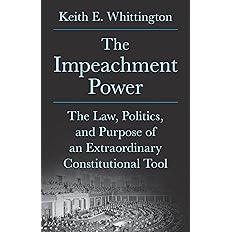
Keith Whittington is a law professor at Yale Law School who has also written Political Foundations of Judicial Supremacy: The Presidency, the Supreme Court, and Constitutional Leadership in U.S. History (2007) and Speak Freely: Why Universities Must Defend Free Speech (2018). Federal impeachment was also the subject of Whittington’s doctoral dissertation (Yale, 1995). In this latest book, Professor Whittington delves into the history of federal impeachment, attempting to explain the foundations, definitions, and intended purposes of the impeachment process.
Whittington makes NO argument about whether specific prior impeachments were valid or not. He acknowledges that impeachment has been rare and is often relegated to the past. However, in today’s hyper-partisan environment, it is becoming increasingly common—and Whittington predicts that we are going to be seeing more use of it. “We have to understand the nature of the impeachment power in order to answer pressing questions about how it should be used and what we can reasonably hope to accomplish by its use.”
“Few principles were so central to the founding era thinking about constitutional design as that power ought to be made to check power…The ultimate and most powerful of these checks—the impeachment power—was entrusted to the congress. With this power, the legislative branch alone was vested with the authority to remove, when necessary, members of the other branches…”
The role of the House. The Constitution provides very little by way of instructions. The role of the House is specified in Article I, § 2, which states, “The House…has the sole power of impeachment.” That’s basically IT for the House—nothing about the how (process and procedure) or the why (purpose).
Whittington explains that impeachment is NOT a criminal trial, suggesting that the full panoply of due process protections guaranteed in the Fifth and Sixth Amendment are inapplicable. That is, the only “punishment” that can be imposed is removal from office. Impeachment does not implicate deprivations of liberty or life; and Congress is expressly prohibited from adopting bills of attainder (Article I, §9).
When an impeachment begins in the House, the Constitution itself contains no rules or blueprint for how the House is to carry out this duty. There are no deadlines or time limits. Rather, the House adopts its own procedures for each impeachment, which varies across whatever rules might be currently in place and the proclivities of each particular session of Congress. If removal is sought because continuing official misbehavior presents a threat to the country or to the Constitutional order, then the better strategy is to impeach as quickly as possible and get Articles over to the Senate as quickly as possible. The purpose of a “speedy trial” is to secure the republic and NOT the rights of the impeachment defendant.
However, the House must anticipate what the Senate will need by way of “evidence” in order to be persuaded. There are no specific rules about how long an impeachment should take, burden of proof, and what Articles of Impeachment should contain, but the House should prepare the Articles with the same care that a prosecutor prepares a grand jury indictment.
Once someone is impeached, it stays on a person’s record forever, even if the Senate fails to convict. Which means that an impeached officer can remain in office and continue whatever form of malfeasance led to the impeachment to begin with—at least until said officer is removed at the next election or by term limit.
The role of the Senate. The Constitution provides a little more instruction for the Senate in Article I, § 3: “The Senate shall have the sole Power to try all Impeachments. When sitting for that Purpose, they shall be on Oath or Affirmation. When the President of the United States is tried, the Chief Justice shall preside: And no Person shall be convicted without the Concurrence of two thirds of the Members present.” Sitting as the Court of Impeachment, the Senate “does so as the highest and final court under the Constitution and thereby exercises an especially solemn constitutional responsibility.”
The Senate impeachment power is limited to removal from office and disqualification from future office of the United States. If the Senate votes to impeach, the officer is instantly removed—removal is NOT discretionary. Although a two-thirds vote is required to impeach and remove, the Senate has the option of a separate vote to permanently disqualify someone from federal office. This separate vote only requires a simple majority. It is unclear whether a request for permanent disqualification must be included in the original Articles of Impeachment coming from the House or the Senate can raise the issue on its own.
It has been very rare for both the House and the Senate to vote for permanent disqualification. This additional penalty has only been imposed three times in the past, and each case involved a federal judge. In two of the cases, the judges had also been involved in corruption across multiple offices. In the case of Judge West Humphreys, the charges involved joining an insurrection against the federal government. Whittington argues that Congress might not view future disqualification as a primary purpose of impeachment, since an individual who has been convicted of impeachable offenses would have a “sufficient stain on their public reputation [to] keep them out of office in the future.” !!!!!!!
Outside of removal and disqualification, the Senate has no further power to punish. Article I § 3 goes on to specify that—although impeachment itself is not a criminal offense—a convicted officer “shall nevertheless be liable and subject to Indictment, Trial, Judgment and Punishment, according to law.” You read that right folks—the Supreme Court’s decision in Trump v. United States, 603 U.S. ____ (2024), granting Trump immunity for “official acts” is contrary to the express provisions in the Constitution!
Whittington warns that although the Senate can disqualify a malfeasant officer from future office of the United States, it cannot banish him from public life: “Such an individual could still launch a social media company, anchor a television talk show, or tour the country holding rallies. In the American republic, even scoundrels are allowed to mount the public stage and try to shape public opinion.”
The role of the Supreme Court. Whittington devotes a chapter to the question of whether or not the Supreme Court can intervene. Spoiler alert! The constitutional answer appears to be NO. Impeachment is a political—not a criminal—process. There is longstanding jurisprudence that the Supreme Court is required to decline accepting cases that involve a “political question.” Moreover, the Supreme Court has specifically pointed to the political question doctrine to explain why courts should not intervene in controversies involving the impeachment power in a case involving Nixon. No, not the former president (who wisely resigned before he could be impeached), but a US district judge named Walter Nixon.
“Writing for the court in 1993, Chief Justice William Rehnquist found that the constitutional questions surrounding impeachment trials were exclusively committed to the Senate by the Constitution itself…Constitutional, legal, and factual questions were all within the sole jurisdiction of the constitutional court of impeachment—the Senate. On matters relating to impeachment, the Senate and not the Supreme Court is the court of last resort.” In the words of Chief Justice Rehnquist: “We agree with the Court of Appeals that opening the door of judicial review to the procedures used by the Senate in trying impeachments would expose the political life of the country to months, or perhaps yeas, of chaos.”
The role of political parties. America’s Constitutional founders distrusted political parties. Whittington argues that they anticipated political disagreements and overly ambitious office-seekers. They hoped to design a system that would channel popular sentiment away from what were disparagingly referred to as “factions.” “Political parties, in [the founders’] view were frequently little more than conspiracies for acquiring power.”
Whittington argues that impeachment as imagined by the founders “fits more neatly into a world without political parties.” But we do not live in such a world today. Rather we are living in a world of hyper-partisanship, where the danger of partisan loyalties could thwart the legitimate objectives of impeachment. Partisan opponents seeking impeachment of a sitting president may be motivated by reasons other than preserving the republic. Conversely, diehard partisans in Congress and also among the voting public can be counted on to rally around an impeachment-embattled president, even when impeachment is obviously warranted.
According to Whittington, the founders intended for impeachment to be a political tool to deal with political—but not criminal—offenses. The purpose therefore is to prevent harm to the republic and not to punish individual officials.
Impeachment has been used in the past primarily against federal judges—who are appointed for life subject to “good behavior.” These impeachments are considered to be less “disruptive” to other democratic ideals: Judges are appointed for life and not elected, and so there is no popular (elections) or other (term limits) means of removing them for bad behavior. It is not surprising that the majority of impeachments have been against judges: over the course of our nation’s history, we have had over 4,000 federal judges, but only 47 presidents.
In addition to higher numbers of potential impeachment candidates, judicial impeachments tend to receive less political opposition in Congress for other reasons: Federal judges are appointed rather than elected, they hold lifetime tenures, and (at least in the past) tend to be politically independent. Impeachment and removal is the only way to ensure public faith in the impartiality and fairness of the judicial system. It is also the only way to let lifetime-tenure judges know that the system will hold them accountable.
What about executive officers like Cabinet officials? Whittington argues that these officers are appointed—and removable—by the President. In the past, when confronted by scandal, these malfeasant officers have “rarely hung on long enough for Congress to start thinking about impeaching them;” instead they either voluntarily resign or are terminated by the President. So there is not a lot of precedent for the impeachment of executive officers.
However, the constitutional drafters intended impeachment to apply to elected officers, even though they were subject to voter approval and limited terms of office. This is clear in Article II, §4 which provides that, “The President, Vice President and all civil Officers of the United States, shall be removed from Office on Impeachment for, and Conviction of, Treason, Bribery, or other high Crimes and Misdemeanors.”
Whittington suggests that impeachments may also serve a less well-defined function than throwing a miscreant out of office. “Partisanship and self-interest can generate significant political pressures that inherited constitutional norms might struggle to contain. When political elites are no longer willing to defend constitutional norms and are unable or unwilling to punish those who violate them, the norms eventually collapse.” Thus, impeachments can serve as an important object lesson when previous norms and guardrails fail to protect the republic from internal corruption and possible destruction.
“Impeachments serve a larger constitution function when the norms at issue are not particularly clear or well accepted. The impeachment itself becomes a vehicle for trying to establish the new normative commitments. The fate of the individual being impeached is less important than the message being sent. The officer in the dock is held up as an object lesson. The impeachment is primarily educative and forward-looking, not punitive and backward-looking. The critical audience for the impeachment is the other current and future federal officers who are being instructed on the proper bounds of acceptable political behavior.”
What is a fair impeachment process, and is fairness even a relevant consideration? Because impeachments are political and not criminal actions, there is no standard of proof—certainly nothing rising to the level of proof beyond a reasonable doubt. Rather, there is only the practical matter of convincing the requisite number of Congresspersons that an impeachable offense has been committed.
Although Whittington repeatedly emphasizes that impeachments are political—and not criminal—proceedings, he nonetheless analogizes the process to a criminal prosecution. The House functions like a grand jury in determining probable cause. Here, evidence is examined, weighed and argued, but the “defendant” does not participate. Only a simple majority is required for the impeachment to go forward. Due process implications are not even a consideration until the case reaches the Senate.
But even at the outset of an impeachment, the House should give certain “political” (but not partisan) questions due consideration. Public officials—whether elected or appointed—do not have a recognized right to the job, and “thus nothing is owed to them before turning them out from that job.” Because a process to address political misdeeds is owed to the people rather than the officeholder, “Congress has a responsibility to be accurate and well informed before removing a potentially meritorious and useful public officer…Congress owes the American people cool deliberation rather than heated passion before intruding itself into the workings of the other three branches.”
Whittington argues that the burden on Congress to ensure a fair process is higher depending on the level of disruptiveness of removal—which is directly tied to the rank and position of the officeholder. The vast majority of federal impeachments have targeted trial court judges. The “institutional repercussions” of pursuing such lower-level impeachments, as well as the costs of making a mistake, are not as serious to the public interest. These concerns ratchet up when the official is a Supreme Court justice, cabinet secretary, or a President. “If the legislature feels justified in displacing such an officer, it had better be prepared to show its work.”
During Trump’s first impeachment in 2019, several of Trump’s Congressional allies (Senator Lindsey Graham and House Minority Leader Kevin McCarthy) as well as White House Counsel Pat Cipollone challenged the impeachment as lacking “constitutionally mandated due process” because the investigation was launched without a vote. Whittington asks the rhetorical question about whether it would be constitutionally proper for the House to launch an impeachment “by means of nothing more than a press conference” and answers in the affirmative. “An impeachment inquiry is not invalid because there has been no vote to formally launch it, nor is a floor vote necessary to authorize it,” unless the House’s own rules require it.
Requiring a pre-impeachment authorization vote ignores the fact that this vote would have to happen before evidence has been made public. House members in swing districts may want to know the strength of the evidence before putting their vote on record. Democratic accountability is NOT thwarted because House members are required to vote on the record to actually impeach. Moreover, Whittington argues that it is “obvious” that requiring a separate vote to authorize an impeachment before the House can proceed to impeachment itself serves no legitimate purpose except “delay and obfuscation.”
The Senate is not obligated to give the impeached officer a trial. Although a simple majority impeachment still stands, the House has neither authority to remove an officer without the Senate, nor the authority to demand a trial. The Senate may either dispense with a trial altogether—in line with a long history of failing to take up votes on other issues brought over by the House—or opt for a very abbreviated one. Whittington suggests that as a matter of “presumption of good faith on the part of its constitutional partners,” (i.e., to maintain civil inter-chamber relations), the Senate should give the House at least some kind of hearing, even when a vote to acquit is a foregone conclusion. “…[S]enators ought to be extraordinarily reluctant to acquit an officer on the basis of such minimal proceedings.”
We have seen the Senate conduct very short trials when acquittal is a foregone conclusion. Conversely, we have never seen a short and fast trial to convict, suggesting that the Senate DOES recognize allowing an impeached officer due process rights. Now that there could be real consequences, it is more likely that the Senate will allow a full evidentiary trial, complete with rules for the admission of evidence, cross-examination, and rebuttal witnesses (no matter how long it takes) before convicting and removing an officer. However, Whittington suggests that there might be circumstances where “time is of the essence,” in which a speedy conviction “might seem not only justifiable but commendable.” He suggests that the founders themselves contemplate the potential need for a speedy trial to convict and gives the examples of (1) a perfidious president is selling out the country to a hostile foreign power, or (2) a traitorous president attempts to mount an insurrection to keep himself in power.
Exactly what are the elements of an impeachable offense? Article II, §4 provides that, “The President, Vice President and all civil Officers of the United States, shall be removed from Office on Impeachment for, and Conviction of, Treason, Bribery, or other high Crimes and Misdemeanors.” Although impeachment is not a criminal trial, there are federal criminal statutes that set out the elements required to “prove” bribery (18 U.S.C. §201) or treason (18 U.S.C. §2381), although these definitions tend to be narrow and somewhat ambiguous. Even more ambiguous is what exactly constitutes a “high crime or misdemeanor.”
Here, Whittington describes and analyzes several theories that have been proposed to interpret the meaning of “high crimes and misdemeanors.” The first is what is known as the “inkblot” theory. The inkblot theory proposes that the founders did NOT want impeachment to be construed as ONLY applying to bribery or treason, but because nothing else is specified, there is essentially no “there” there. “A constitutional provision with no clear meaning cannot authorize government action…This is a disempowering interpretation that would effectively limit the scope of the impeachment clause to the listed offenses of treason and bribery.”
The inkblot theory is analogized to the provision in the Ninth Amendment that says, “The enumeration in the Constitution, of certain rights, shall not be construed to disparage others retained by the people.” The purpose of the Ninth amendment was to prevent someone (most likely, a future corporate Supreme Court Justice) from an interpretation that would expressly limit rights to those contained in the Bill of Rights. This has also led to a line of jurisprudence arguing that such textual ambiguity opens the door for courts to make up new rights for which there is no historical evidence. One law school professor admonished us that “the Ninth Amendment—whether on an exam or in a real court—is never the right answer.”
A second interpretation was proposed by former President Gerald Ford when he occupied the position of House minority leader during the impeachment of Justice William O. Douglas in 1970. “…[A]n impeachable offense is whatever a majority of the House of Representatives considers it to be at any given moment in history.” This is the maximally empowering interpretation. (Incidentally, Ford’s impeachment effort against Justice Douglas failed.)
A third interpretation attempts to simplify (or standardize) impeachments by proposing that impeachable offenses are the same as ordinary crimes. “Legislators who prefer to outsource impeachment investigations to special counsels benefit from a list of impeachable offenses that is coterminous with the criminal code…Alan Dershowitz has been the most prominent advocate of this view of late, but he is part of a long tradition of zealous defense attorneys who have sought to help their clients escape conviction in the Senate by arguing that the House had exceeded its constitutional authority.”
According to Whittington, “Most of the historic and scholarly debate over the meaning of high crimes has taken place in the space between those narrow and broad readings.” Prior impeachments of judges did not always involve crimes, but rather behavior that was inappropriate and “grossly incompatible with the office.” For example, judges were impeached on the basis of appearing on the bench during trial in a state of intoxication, sexual misconduct with court employees, and permitting partisan views to influence conduct during trials.
Whittington claims that fewer than one-third of all House Articles of Impeachment have expressly charged a criminal violation. Thus, while a criminal violation is not required, there must be something more by way of malfeasance than ordinary political and policy disagreements. Whittington covers the history and evolving logic of these arguments in greater detail.
“It is easier to think in terms of crimes and rule violations. It is harder to think in terms of abuse of power. Charges of abuse are always more uncertain and controversial.”
Whittington argues that the “foundational thinking” behind both the American and French revolutions was to keep government small and divided to avoid the abuse of power. The “eternal dilemma of politics is that the very power that is entrusted to officeholders to accomplish public aims” is almost certain to be abused. But the mere possibility that a power might be abused could not be a good reason for withholding the power. “Elections, a limited term of office, and a host of checks and balances would not necessarily be enough to protect the republic from an unhinged or villainous president…Constitutions are meaningless if they cannot be effectively vindicated when they are violated.”
Whittington suggests that impeachment—as a political solution—should be used only when “all else has failed.” Rather than analyzing the situation like a criminal prosecutor (does the behavior meet all the elements of a specified crime), the operative question is whether the “state must be secured against serious threats to the system of government. Impeachments are a matter of constitutional politics, not legalities.” Whittington argues Congress must also determine whether “the political problem of intolerable bad behavior” can be resolved by other means, and whether the push to impeach might be driven by “exaggerated party spirit.”
Presidents under threat of impeachment are “well-positioned to work their way out of impeachment territory,” but this requires confronting the political problems directly and “reducing the threat from one of constitutional import to one of normal politics to be resolved by ordinary political means.” This requires a thorough thinking-through (on both sides) of non-impeachment remedies. That is, impeachment should ideally be the remedy of last resort.
If a President acts outside the powers authorized by Article 2, then a standard remedy is to sue for an injunction based on the Separation of Powers doctrine. This does NOT mean that such action is not impeachable, but rather that remedy through the court system might be more logistically (or politically) feasible. “Judicial review has several potential advantages over impeachment, but those advantages are conditional;” i.e., like impeachment, the outcome is not guaranteed. Here Whittington asks whether judges who have been appointed by the president might be disinclined to rule against him and makes the argument for judicial independence from the executive.
Complicating the alternative of challenging Presidential action in the courts are recent judicial interpretations that have significantly expanded Presidential powers. “On the one hand, we as a country have been fortunate that presidents rarely engage in obviously unconstitutional activity. On the other hand, presidential powers are sufficiently expansive that even credible counterfactuals of presidents exceeding their powers are contestable.”
Another presumption that applies if you expect court action to remedy constitutional overreach by a president is willingness and capacity of courts to take action. If “A president willing to exceed the limits of presidential power could not be trusted to stop doing so or to voluntarily retreat…judicial review would be inadequate and the defenders of the constitutional order would need to take more drastic measure to remove the usurper from power.” Whittington suggests that impeachment may be the next step before the only remedies would be revolution or assassination.
Another problem Whittington addresses is an overly restrictive focus on rules and procedures. “A constitutionalism concerned only with a system of rules is likely to be unworkable and perverse. …it encourages an ethos of testing, circumventing, and subverting the rules while in pursuit of short-term political gains. The constitutional rules will routinely be bent, if not broken, if we do not preserve a constitutional culture that emphasizes and values the importance of limits on political power.”
Defenders of the republic (and democracy itself) need to be mindful of threats that do not neatly fit into definable crimes or standard separation-of-powers violations. Even when a litany of impeachable offenses does not immediately “threaten to topple constitutional government…an individual who engages in unchecked abuses of office may impose intolerable costs on the country.” Whittington suggests that there be a distinction between whether the officeholder has exercised powers that they do not lawfully possess or whether they have abused the lawful powers that they do possess; i.e., “the abuse of legitimate power or the exercise of a usurped one.”
Whittington refrains from judgment about whether the Trump impeachments were justified or not, but he nonetheless has something to say about them. One such comment involves the “slow” pace of the second impeachment, which was done while Trump was in the last weeks of a lame duck term. “The House did not move quickly to impeach the president after the events of January 6, and it waited until after Joe Biden was sworn in as president before getting around to demanding a trial in the Senate. One can only assume that the congressional leadership had received some assurances behind the scenes that President Trump would not misbehave in the nearly two weeks that he was allowed to continue to occupy the White House after the electoral votes had been counted.” The unusual thing about this was that removal was not viewed as the primary objective, but rather the (unfulfilled) intent was to foreclose a resurgent Trump from regaining the presidency. Indeed, the impeachment articles against Trump in the aftermath of January 6th did include disqualification from all future office.
Trump has the current Supreme Court so thoroughly up his ass in his grasp that he took to Twitter after the Mueller report was released to declare that “If the partisan Dems ever tried to Impeach, I would first head to the U.S. Supreme Court.” Whittington suggests that Trump did not come up with this idea on his own. Alan Dershowitz—who had become a close advisor and later served on Trump’s impeachment defense team, had proposed that if Trump was impeached he “…could and should refuse to leave office on the ground that his impeachment and removal were unconstitutional.” Dershowitz’ statement implied that no impeachment could be final until it had been affirmed by the Supreme Court.
Whittington suggests that most of Trump’s offenses, that while not blatantly “unconstitutional” in the traditional sense, were “unpresidential” to a level that could arguably operate as a threat to the country:
“Donald Trump spent his presidency insisting that he need not behave in a manner that might be traditionally viewed as “presidential.” He broke norms large and small. When his own interests were threatened, he did not hesitate to do whatever seemed necessary to protect and advance them. His efforts to use his leverage over a foreign power to disadvantage his electoral rivals and enhance his own electoral fortunes gave rise to his first impeachment. His willingness to use the powers of his office to stonewall congressional investigations into what he had done provided the foundation for an additional article of impeachment. His extended effort to subvert confidence in the conduct and outcome of the presidential election, to seek avenues to overturn the legitimate election results, and to stoke passions that eventually gave rise to an attack on the Capitol to stop the counting and certification of presidential electoral votes led to an unprecedented second impeachment. Such behavior might not have been out of character had Trump still been a real estate developer fighting off creditors or a celebrity seeking to keep potential scandals out of the public view. Hyperaggressive actions to advance purely personal interest might be tolerable, if not laudable, in the private sphere. When undertaken by a sitting president in the public sphere, it can be corrupting of the constitutional order.”
Whittington discusses the less identifiable threats to constitutional order presented by exaggerated deference to decisions of voters and the slippery slope toward autocracy. This line of arguments echoes similar arguments about the “tyranny of the majority” made by Alexis de Tocqueville’s Democracy in America and Thomas Dye’s Irony of Democracy: If you allow “the people” to rule without checks from the system itself (i.e., elites), you won’t have a sustainable democracy.
Whittington cites an Argentinian political scientist, who describes the real danger of presidents who “exalt in their popular mandate,” and disregard “any horizontal checks on their power as an unnecessary hindrance.” Whittington argues that such “delegative democracies” are often not very stable, because “once elevated, such presidential strongmen are tempted to discard the vertical check of elections as well. The democratic sensibility in such a situation is real [impeachments result in overturning a decision of the voters] but not entirely healthy or sustainable. If our democratic sentiments have truly outpaced the impeachment power, it would be a short step from there to presidents insisting that neither should they be bound by the decrees of nine unelected justices or be hindered by obstructionist legislators.” Indeed, such a president would now be truly above the law and totally unaccountable.